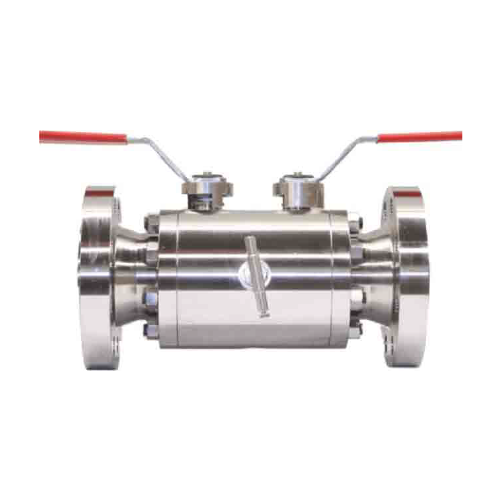
In the oil & gas industry, personnel safety during maintenance depends on being absolutely certain that a section of pipeline is isolated and de-pressurised before anyone opens a flange or performs hot work. A Double Block and Bleed (DBB) valve is specifically designed to provide that guarantee — in a single, compact body.
This article covers what a DBB valve is, how it works mechanically, what API 6D says about it, and when a DBB is the right choice versus two separate isolation valves with a bleed between them.
What Is a Double Block and Bleed Valve?
A double block and bleed valve is a single valve body that contains two independent seating surfaces, both of which block flow from the same upstream source, with a cavity between them that can be vented (bled) to atmosphere or a drain system.
When both seats are closed and the bleed port is open, any leak through the upstream seat accumulates in the cavity and drains away — rather than pressurising the downstream system. This gives the downstream side a guaranteed zero-pressure condition, which is what makes maintenance safe.
How a DBB Ball Valve Works
The most common DBB configuration uses a ball valve with two ball seats (upstream and downstream) and a body cavity bleed connection. Here's the sequence:
- Both seats closed: The ball is rotated to the closed position. The upstream seat blocks line pressure from entering the cavity. The downstream seat blocks any residual downstream pressure from entering the cavity.
- Bleed port opened: The bleed valve (needle valve or integral plug) on the body cavity is opened. Any leakage past the upstream seat drains out rather than building up pressure.
- Cavity pressure monitored: If the cavity builds pressure with the bleed closed, it indicates the upstream seat is leaking — the valve needs maintenance or replacement.
- Downstream work proceeds safely: With bleed open and cavity at zero pressure, downstream piping is confirmed safe to open.
API 6D Definition of Double Block and Bleed
API 6D (Specification for Pipeline and Piping Valves) defines DBB specifically:
"Valve design in which a single valve with two seating surfaces, in the closed position, provides a seal against pressure from both ends of the valve with a means of venting/bleeding the cavity between the seating surfaces."
Crucially, API 6D distinguishes DBB from Double Isolation and Bleed (DIB):
| Feature | DBB (Double Block & Bleed) | DIB (Double Isolation & Bleed) |
|---|---|---|
| Seat sealing direction | Both seats seal against upstream pressure only | Each seat seals independently (bi-directional) |
| Cavity pressure under leak | Can rise if upstream seat leaks | Cavity stays at zero — downstream seat holds |
| API 6D designation | DBB | DIB-1 or DIB-2 |
| Typical application | Pipeline isolation, instrument isolation | Chemical injection, safety-critical isolation |
| Cost | Lower | Higher (bi-directional seat design) |
Where DBB Valves Are Used
- Pipeline isolation: Sectioning pipelines for pigging, maintenance, or emergency shutdown
- Chemical injection: Isolating injection quills and chemical lines from the main process
- Instrument isolation: Compact DBB/DIB valves on pressure taps, flow meters, and analyser connections (IDBB valves)
- Pig launchers and receivers: Providing confirmed isolation before opening the closure
- Hot-tap connections: Providing a bleed-verified safe condition before cutting into live pipe
- Metering skids: Fiscal metering isolation where cross-contamination must be prevented
DBB Valve Sizes and Pressure Classes
Novel Valves manufactures DBB ball valves in the following range:
| Parameter | Range |
|---|---|
| Size | 1" to 24" (DN25 to DN600) |
| Pressure Class | ASME Class 150 to 2500 (PN 20 to PN 420) |
| Body material | A216 WCB, A351 CF8M, A352 LCC, Duplex SS |
| Seat material | PTFE (soft), Stellite (metal), Tungsten carbide |
| End connections | Flanged RF/RTJ, Butt weld, Socket weld |
| Certification | API 6D Monogram, CE PED, IBR |
DBB vs Two Separate Valves: Which Is Better?
| Criteria | Single DBB Valve | Two Valves + Bleed Between |
|---|---|---|
| Space required | Compact — single face-to-face dimension | 2× valve length + spool + bleed valve |
| Weight | Lower | Higher |
| Leak points | Fewer flanged joints | More potential leak points |
| Testing | Factory-tested as one unit per API 6D | Each valve tested separately |
| Cost (upfront) | Higher per unit | Lower per unit, higher installed cost |
| Maintenance | Single valve to maintain | Two valves + bleed valve |
| Offshore/subsea | Preferred (space/weight critical) | Less practical |
DBB Valve Testing per API 6D
All Novel Valves DBB ball valves undergo the following production tests before dispatch:
- Shell (hydrostatic) test: 1.5× CWP — verifies body/bonnet integrity
- Seat test (both seats): 1.1× CWP — each seat tested independently
- Low-pressure seat test: 5–7 bar air — verifies soft-seat integrity
- Cavity bleed test: Confirms bleed port opens, cavity drains, and holds zero pressure with both seats closed
Full Material Test Reports (MTR), Pressure Test Reports, and API 6D compliance certificates are provided with every valve.
Need API 6D certified DBB ball valves for your pipeline or process project? Novel Valves manufactures and exports DBB valves in sizes 1" to 24" with full documentation.
View DBB Valve RangeFrequently Asked Questions
Is a DBB valve the same as a double block valve?
No. A double block valve (without bleed) has two seating surfaces but no bleed port. A DBB valve has both — two block seats plus a cavity bleed. The bleed is what makes it safe for maintenance by allowing the cavity to be positively vented.
What is the difference between DBB and DIB?
In a DBB valve, both seats seal against upstream pressure — if the upstream seat leaks into the cavity, cavity pressure rises. In a DIB valve, each seat is designed to independently seal in its respective direction, so even if the upstream seat leaks into the cavity, the downstream seat holds the downstream side isolated. DIB provides a higher level of safety.
Can a DBB valve replace two gate valves and a bleed?
Yes, in most cases. A single DBB ball valve is the compact, factory-tested equivalent of two gate valves + an intermediate bleed valve. It is preferred for new-build offshore platforms, metering skids, and any installation where weight and space savings are critical.
What sizes do DBB valves come in?
Novel Valves manufactures DBB ball valves from 1" to 24" in ASME Class 150 through 2500. Custom sizes and pressure classes are available on request.